How much life insurance do I need in Canada: Methods & examples
How much life insurance do I need? Learn 10×, DIME and FNA methods for Canadians, with real examples and caveats. Clear, compliant guidance.

On this page
- Key Takeaways
- Determine whether you need life insurance
- How much life insurance do I need?
- Calculate how much coverage you need: 4 Methods
- Real-life example: how to calculate your life insurance coverage
- How long do you need life insurance coverage for?
- Do I need life insurance if I have a lot of savings?
- How does life insurance protect a mortgage?
- Common reasons why people buy life insurance in Canada
- Are employer benefits sufficient?
- How much life insurance I need – Conclusion
- Frequently asked questions about how much life insurance you need
Understanding “how much life insurance do I need” is one of the most important steps when planning your family’s financial protection. The right amount ensures your loved ones can continue their lifestyle, pay off debts, and fund future goals if something happens to you. While there’s no universal number, there are reliable ways to calculate it, ranging from simple income multiples to full financial-needs analyses.
This guide explains each method, from 10× income and the DIME formula to more detailed assessments, with examples to help you find coverage that fits your goals, obligations, and budget.
Determine whether you need life insurance
Not all individuals require life insurance. Those who have amassed sufficient wealth and assets to provide for their own and their loved one’s needs in the case of their death can forego purchasing life insurance, particularly a term policy.
On the other hand, according to experts, there are categories of people who should never be without life insurance: couples, mortgage holders, new parents, parents of minors, children (minors), divorcing parties, and business owners.
Evaluate your financial dependents: Consider who depends on your income or financial support. Suppose you have dependents such as a spouse, children, or elderly parents who rely on your income to cover living expenses, education costs, or debt repayment. In that case, life insurance can provide a financial safety net for them in case of their untimely passing. Families may need life insurance to cover significant financial obligations like mortgages and education costs for children.
Assess your debts and financial obligations: Take stock of your outstanding debts, such as mortgages, car loans, or credit card debts. If your loved ones struggle to manage these obligations in your absence, life insurance can help cover such debts, easing their financial burden.
Consider funeral and final expenses: Funerals and related costs can be costly. Life insurance can help cover these expenses, relieving your family of the financial burden during a challenging time.
Evaluate existing financial resources: Consider your savings, investments, and any other assets that could be used to support your dependents in case of death. If these resources are not sufficient to meet your family’s long-term financial needs, life insurance can provide an additional layer of financial protection.
Future financial goals: Consider your long-term goals, such as funding your children’s education or leaving an inheritance. Estimating education costs involves accounting for post-secondary education for children, which can be significant. Life insurance can be a tool to help ensure that these goals are achieved, even if you’re no longer there to provide for them.
How much life insurance do I need?

Determining how much life insurance you need starts with one key question: what would your family need to maintain financial stability if your income suddenly stopped?
For most Canadians, coverage should be enough to:
- Replace income for several years,
- Pay off large debts such as a mortgage or car loan,
- Cover final expenses, and
- Fund future goals such as education or retirement savings for a spouse.
A good starting point is calculating your outstanding debts, the number of years of income your dependents would need, and the total cost of long-term goals. Subtract existing savings, investments, and assets that could help bridge the gap.
The result is your coverage gap, the amount of insurance required to keep your family secure.
If that feels complex, the 10× income rule or the DIME formula can simplify it. Both methods offer quick estimates and are easy to adjust as life changes. The key is to revisit your coverage every few years or after major milestones like a new home, a child, or a business venture.
Let’s consider an example to determine whether you need life insurance:
Meet Nicole: Nicole is a 35-year-old married woman with two young children. She works full-time and earns an annual income of $60,000. Here’s how she can assess her need for life insurance:
- Evaluate financial dependents: Nicole has two young children who depend on her income to cover living expenses and future education costs. If she were to pass away unexpectedly, her spouse and children would face financial challenges without her income.
- Assess debts and financial Obligations: Nicole and her spouse have a mortgage on their home and an outstanding car loan. If Nicole were to pass away, her spouse may struggle to handle these financial obligations alone.
- Consider funeral and final expenses: Funerals can be costly, and Nicole would want to ensure that her family is not burdened with these expenses in addition to their grief.
- Evaluate existing financial resources: Nicole and her spouse have some savings and investments, but they are not substantial enough to fully cover long-term financial needs and goals in case of her untimely death.
- Future financial goals: Nicole and her spouse aspire to provide their children with a college education and save for retirement. Inflation should be considered when calculating income replacement needs to hedge against decreasing purchasing power.
Based on this assessment, Nicole would benefit from having life insurance coverage. The death benefit would provide a financial safety net for her family, help cover outstanding debts and future expenses, and protect their long-term financial goals even if she is no longer there to contribute financially.
Calculate how much coverage you need: 4 Methods
A financial needs analysis is an assessment that helps determine the appropriate amount of life insurance coverage needed to meet specific financial obligations and goals. It involves evaluating various economic factors to ensure the coverage adequately addresses the policyholder’s unique circumstances. Here are four different methods to calculate your insurance coverage amount:
Method 1: Multiply your annual income by 10x
This formula is a simplified rule of thumb that some financial experts use to estimate the amount of life insurance coverage a person may need.

You would multiply your annual income by 10. For example, if your annual income is $50,000, the formula suggests a life insurance coverage amount of $500,000 (10 times your annual income).
This coverage amount is meant to give your loved ones financial support if you pass away, helping them with living expenses such as daily living costs, mortgage or rent payments, debts, education expenses, and maintaining their current standard of living.
This method is the most straightforward way to determine your life insurance needs, but it has limitations. The “multiply by 10x” formula does not comprehensively consider your finances or your family’s necessities. Additionally, something else is needed for stay-at-home parents. Even if they may not earn an income, a parent who stays at home requires life insurance just as much as a parent who works. If a stay-at-home parent passes away, the surviving spouse must employ someone to assume some or all of the deceased’s tasks.
The formula also does not account for other sources of income or assets you may have, such as investments, retirement savings, or spousal income. These resources can reduce the need for a higher life insurance coverage amount.
If you plan to have children, using a fixed multiple may not accurately reflect your insurance needs. Consider education costs or leaving an inheritance. If you have more than one child, you may require a more significant amount of money, and additional coverage beyond the formula’s recommendation may be necessary.
Method 2: The DIME formula
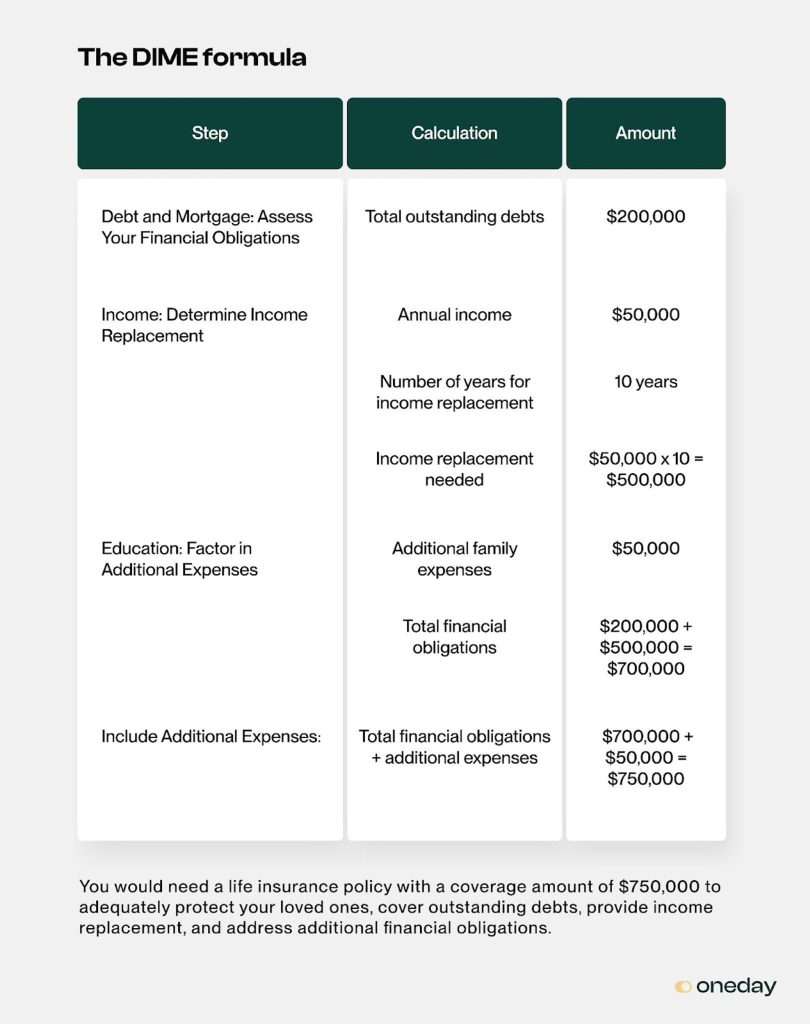
The DIME formula is the most all-encompassing of the four rules of thumb. It guarantees that your life insurance covers four essential areas: Debt, Income, Mortgage, and Education. Here’s an example of how you can use DIME formula.
How to calculate the coverage amount
- Debt and Mortgage: Assess Your Financial Obligations
- Add outstanding debts like mortgages, car loans, student loans, and credit card debt. For example, let’s say your total debts amount to $200,000.
- Income: Determine Income Replacement
- Estimate the number of years your dependents will need financial support if you pass away. Let’s assume it’s 10 years.
- Calculate your annual income. For this example, let’s say it’s $50,000.
- Multiply your annual income by the number of years to estimate the income replacement needed. In this case, $50,000 x 10 = $500,000.
- Education: Factor in Additional Expenses
- Consider any additional expenses your family would face, such as funeral costs, ongoing education expenses for your children, or future financial goals. Let’s assume these expenses total $50,000.
- Add Financial Obligations and Income Replacement
- Add your outstanding debts and income replacement amount together: $200,000 + $500,000 = $700,000.
- Include Additional Expenses:
- Add the additional expenses to the total amount calculated: $700,000 + $50,000 = $750,000.
In this example, you would need a life insurance policy with a coverage amount of $750,000 to protect your loved ones adequately, cover outstanding debts, provide income replacement, and address additional financial obligations.
Method 3: Financial needs analysis (FNA) method
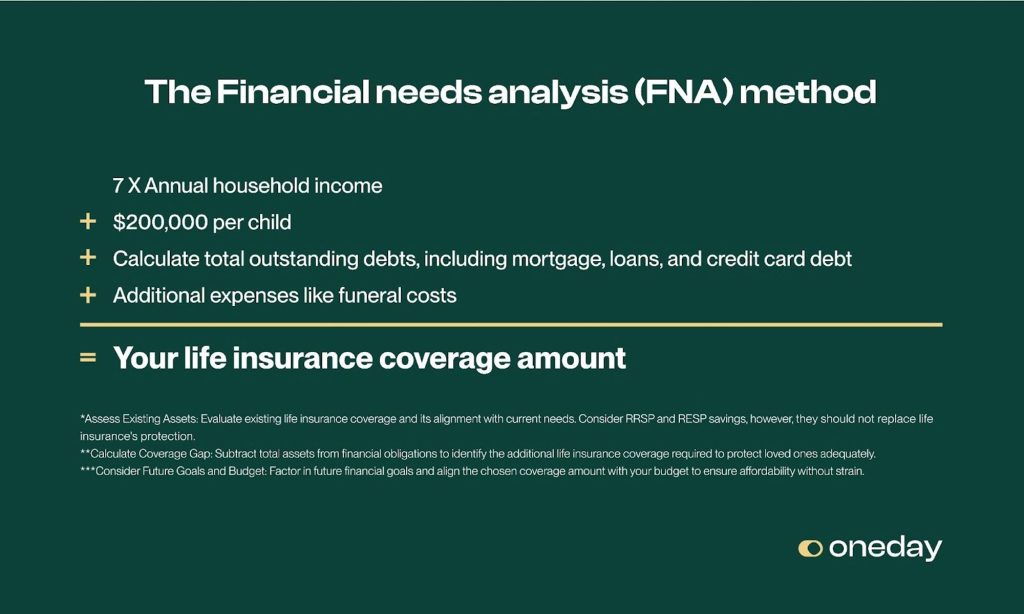
- Determine Your financial obligations:
- Add up your outstanding debts. Consider potential changes in circumstances – new baby, house upgrade, or upcoming significant expenses. Consider funeral expenses, ranging from $5,000 to $15,000 or more.
- Factor in future expenses, such as education costs for your children or ongoing financial support for your dependents
- Assess your existing assets:
- Existing coverage: If your existing life insurance policy does not provide sufficient coverage to meet your current financial obligations or future goals, obtaining an additional policy can help bridge the gap. Additionally, you may have different beneficiaries or specific financial obligations that require separate policies. For example, one policy to provide for your spouse and children and another to cover business-related expenses or estate taxes.
- RRSP: Investing in an RRSP (Registered Retirement Savings Plan) in Canada is a significant step toward building a retirement fund. However, it’s important to note that RRSPs primarily serve as a retirement savings vehicle and may not provide adequate life insurance coverage for your specific needs. Life insurance safeguards your loved ones if you pass away, whereas RRSPs are geared towards saving for retirement and generating income. Your RRSP investments can be factored into your overall financial assessment but should not be relied upon solely for life insurance coverage.
- RESP: Investing in an RESP (Registered Education Savings Plan) in Canada is an excellent way to save for your child’s education. However, an RESP primarily funds education expenses and may not provide adequate life insurance coverage for your specific needs. Consider your RESP savings and deduct these resources from the required coverage amount to identify potential gaps.
- Investment portfolio: While investing in stocks and mutual funds can contribute to your financial well-being, life insurance serves a different purpose. A life insurance payout provides an immediate cash infusion that can help your loved ones meet their financial obligations and maintain their standard of living without relying solely on the liquidation of investments, which may take time and is subject to market fluctuations.
- Calculate the coverage gap:
- Subtract your total assets from your total financial obligations.
- The resulting amount represents the coverage gap – the additional life insurance coverage you need to protect your loved ones fully.
- Future goals:
- Evaluate any future financial goals you would like your life insurance to support, such as leaving an inheritance.
- Know your budget:
- Determine how much you can comfortably afford to pay in life insurance premiums.
- Ensure that your coverage amount aligns with your budget without causing financial strain.
Method 4: Dave Ramsey’s advice
Dave Ramsey, a well-known personal finance expert, recommends a straightforward approach to life insurance, his advice centres around purchasing term life insurance policies rather than permanent ones.
- Opt for Term life insurance: Ramsey emphasizes the importance of term life insurance, which provides coverage for a specific term (e.g., 10, 20, or 30 years). Term policies generally offer higher coverage at more affordable premiums than permanent life insurance policies.
- Calculate the coverage amount: Ramsey suggests obtaining life insurance coverage equal to 10–12 times your annual income. This coverage amount will replace your income and provide financial security to your dependents if you pass away.
- Choose level premiums: Select term policies with level premiums, meaning the premiums remain the same throughout the policy term. This provides predictability and stability in your budget.
- Consider policy length: Determine the appropriate term length based on your financial obligations and the time frame during which your loved ones will rely on your income. For example, if you have young children, consider a policy that covers you until they become financially independent.
- Avoid cash value or whole life policies: According to Ramsey, cash value or whole life insurance policies are not recommended due to their higher costs and complex features. He suggests focusing on term life insurance for its simplicity and affordability.
Real-life example: how to calculate your life insurance coverage
John is a 35-year-old individual who is married and has two children. John’s primary goals are to provide financial security for his family, cover outstanding debts, and ensure his children’s education expenses are covered.
- Assess financial obligations: John has a mortgage balance of $250,000, a car loan of $20,000, and a credit card debt of $5,000. His total outstanding debts amount to $275,000.
- Calculate income replacement: John’s annual income is $80,000. He estimates that his family would need income replacement for 20 years if he were to pass away prematurely. Multiplying his yearly income by the number of years, we get $80,000 x 20 = $1,600,000.
- Education expenses: John wants to ensure that his children’s education expenses are covered. He estimates the cost of each child’s education to be $50,000. So the total education expense comes to $100,000.
- Consider Other Factors: John evaluates his future financial goals and the potential need for additional coverage to leave an inheritance or provide for his spouse’s retirement.
Based on this scenario, let’s explore the options:
- Term Life Insurance: If John chooses term life insurance, he might consider a policy with a coverage amount of at least $1,975,000, which includes the outstanding debts, income replacement, and education expenses ($275,000 + $1,600,000 + $100,000). He can select a term length that aligns with his financial obligations, such as a 20 or 25-year term.
- Permanent Life Insurance: If John opts for permanent life insurance, he can consider the coverage amount based on the same factors. Permanent life insurance provides lifelong coverage and often includes a cash value component, but the premiums are typically higher than term life insurance.
In conclusion, term life insurance offers higher coverage at a lower cost and may be suitable for covering specific financial obligations for a set period. On the other hand, permanent life insurance provides lifelong coverage and can accumulate cash value, but it comes with higher premiums.
How long do you need life insurance coverage for?
There is no one way to go about this. Nevertheless, you should take these factors into account when choosing how much coverage and how many years you need:
Your age
Your age is a valuable predictor of how long you will continue to provide your family with an income that would need to be replaced if you were to pass away. If your beneficiaries depend on your income, you should choose a policy that lasts until you plan to retire or until you have sufficient savings and assets to provide financial security for your family.
Your mortgage or other debt
Life insurance coverage should last at least as long as it will take you to pay off your mortgage or credit card balances. This can prevent your loved ones from inheriting your debts in the event of your death.
Your children
If you have young children or plan to have them soon, term life insurance for 15 or 20 years or longer can stabilize your family. If something were to happen to you, your policy might assist in supporting your children until they complete college or become independent.
Do I need life insurance if I have a lot of savings?
There is no doubt you need life insurance, as it is also a wise way to save. Term life insurance can offer your family appropriate financial security in a terminal emergency. This directly supports your spouse and children’s living expenses and critical financial goals.
How does life insurance protect a mortgage?
You can include the mortgage balance so your family can remain in their home without worrying about foreclosure. If income replacement (above) already accounts for mortgage payments and other costs, there is no need to add additional mortgage funds. A mortgage life insurance policy gives a death benefit to the lender if a home borrower passes away during the loan’s term. These term insurance are designed to correspond to the number of years remaining on a mortgage, with death benefit levels that change annually to reflect the yearly reduction in the mortgage balance.
Borrowers whose lender forces them to obtain mortgage life insurance may also choose permanent life insurance, allowing them to name new beneficiaries once the mortgage obligation is met.
Common reasons why people buy life insurance in Canada
- Financial protection for loved ones: According to a study by the Life Insurance Marketing and Research Association (LIMRA), 84% of Canadians cited protecting their loved ones as the main reason for buying life insurance. The Canadian Life and Health Insurance Association (CLHIA) reported that in 2019, individual life insurance policies provided over $44 billion in income replacement and family protection coverage. Approximately 40% of Canadians believe their families would face financial hardship within six months should the primary wage earner die unexpectedly.
- Debt coverage: According to Statistics Canada, the average household debt-to-income ratio in Canada reached 170.7% in 2020, making life insurance an essential consideration for debt coverage.
- Business continuity: The Canadian Federation of Independent Business (CFIB) reported that 55% of Canadian small business owners have life insurance policies, with 30% citing business protection as the primary reason.
Are employer benefits sufficient?
Employer-provided life insurance is a great perk but rarely sufficient on its own. Most group plans offer coverage equal to one or two times your annual salary, far below what’s needed for full income replacement or debt coverage.
If you leave your job, that coverage typically ends, leaving your family unprotected. Supplemental personal life insurance ensures continuous protection regardless of career changes or employer policies.
Ideally, treat workplace coverage as a starting layer, not your entire plan. Personal life insurance follows you for the long term and can be tailored to your exact needs and budget.
How much life insurance I need – Conclusion
The right coverage amount depends on your income, debts, and family’s goals. Whether you use 10× income or a full financial analysis, the key is protecting those who rely on you most. Review your plan regularly and adjust as your life evolves. Want help calculating your ideal coverage? Get a quick quote today and see how affordable the right protection can be.
Frequently asked questions about how much life insurance you need
Do life insurance policies cost more with age?
In general, life insurance is less expensive for younger, healthier individuals. Therefore, you should purchase it as soon as possible if you believe you will require it now or in the future. For instance, a young couple may buy life insurance upon engagement or childbirth.
How long should my term life insurance be?
Your term life insurance policy should match the duration of your financial obligations and outstanding debts. If you do not get a good term length and need to purchase additional life insurance coverage in the future, your premiums will be significantly higher.
Should I continue my life insurance coverage after the policy expires?
When a term life insurance policy expires, the policyholder is not required to take action. The insurance provider notifies the policyholder that the policy is no longer in effect, the policyholder ceases paying premiums, and there is no potential death benefit. Most term policies can be renewed but at higher rates.
How much life insurance coverage is required at the age of 40?
Calculating the amount of life insurance you’ll need begins with calculating the difference between your assets and your responsibilities, regardless of age. At age 40, you may be in a moment of transition, between a job and retirement, with children in college or living independently. All of these factors impact the amount of life insurance you may require.
Should I buy life insurance at the age of 70?
At age 70, your debts and obligations may be far lower than they were earlier. You may have paid off your mortgage, your children may be adults, and you may be approaching retirement or already retired.
Consider purchasing life insurance to help your loved ones pay off any outstanding debts in the event of death. Using the gap between your assets and debts, you may determine the quantity of coverage you’ll need.
If you are still determining the value of life insurance, remember that it is always preferable to purchase a smaller coverage than to have none. Any life insurance can help alleviate the financial strain on your family during your death. Protecting your family requires ensuring they have a financial safety net; even a modest net is preferable to none.